

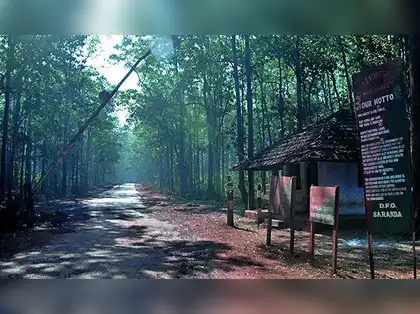
In a landmark move for environmental conservation, the Supreme Court of India has granted protection to 314 sq. km of the untouched Sal forest in Jharkhand’s Saranda region. Known for its dense canopy, rich biodiversity, and longstanding indigenous presence, the Saranda forest division is one of India’s most ecologically significant landscapes. This decision marks a crucial step toward preserving a region that has historically faced the threat of mining, industrialisation, and habitat fragmentation.
Saranda, which translates to “land of seven hundred hills,” is home to some of the country’s most pristine stretches of Sal forest. It supports a wide range of endangered wildlife species, including elephants, leopards, pangolins, and several rare birds. The forest is also inhabited by tribal communities, whose cultural traditions and livelihoods are closely intertwined with the natural ecosystem. For generations, these communities have depended on the forest for food, shelter, medicinal plants, and traditional practices, making its protection not just an environmental priority but also a socio-cultural necessity.
The State government initially proposed a much smaller area for sanctuary status, raising concerns among environmentalists and forest rights advocates. However, during the proceedings, the State clarified that the extended 314 sq. km area being considered by the Court contains no active or proposed mines. This statement played a key role in enabling the Court to move forward with full protection, as it eliminated potential conflict with industrial or mining interests. It is particularly noteworthy because Saranda accounts for nearly 26% of India’s iron ore reserves—a fact that has often placed the forest at the centre of policy battles between conservation and resource extraction.
For decades, mining activities have encroached upon the periphery of Saranda, leading to forest degradation, loss of wildlife corridors, and pollution of local water sources. The Supreme Court’s decision thus acts as a safeguard against further ecological damage. It ensures that the core forest area remains free from mining leases and continues to function as an intact ecosystem—crucial for wildlife movement, carbon storage, and climate resilience.
Environmental experts have welcomed the judgment, noting that protecting large, contiguous stretches of forest is essential for maintaining biodiversity and preventing the isolation of wildlife populations. The ruling also strengthens India’s commitment to conserving its natural heritage amid increasing developmental pressures. For tribal communities, the move offers reassurance that their ancestral lands and traditional ways of life will not be compromised by industrial expansion.
The Court’s intervention also sends an important message regarding the balance between economic interests and ecological preservation. While Jharkhand remains a mining-intensive state, the judgment underscores that not all resource-rich landscapes should be opened for extraction. Some must be preserved for their irreplaceable ecological value.
Note: Content and images are for informational use only. For any concerns, contact us at info@rajasthaninews.com.

Previous Post

Next Post
"इको-फ्रेंडली इनोवेश...
Related Post