
Education
Centre Chairs Meeting to Chart Roadmap for ‘Samagra Shiksha 3.0’ School Education Programme
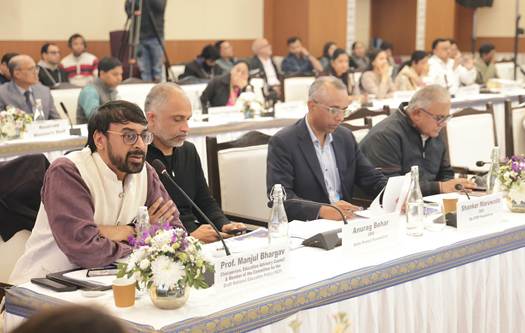
The Union government has chaired a high-level meeting with States and Union Territories to chart the pathway for the next phase of the flagship school education programme, ‘Samagra Shiksha 3.0’. The discussions focused on aligning school education with future-ready skills, ensuring curriculum equivalence across State boards, and integrating artificial intelligence (AI) as a core component of learning, in line with the long-term national vision of achieving a ‘Viksit Bharat’.
Officials at the meeting underlined the need for greater uniformity in learning outcomes across different education boards while respecting India’s federal structure. Curriculum equivalence, rather than uniformity, was highlighted as a key goal—aimed at ensuring that students across States acquire comparable competencies, skills, and foundational knowledge regardless of the board they study under. This, policymakers noted, would help reduce disparities in higher education access and employability.
A major emphasis of the discussions was the inclusion of artificial intelligence and emerging technologies in school education. The Centre proposed that AI literacy be introduced in a structured and age-appropriate manner, starting from the foundational and middle school levels and expanding at the secondary stage. The objective is to equip students with conceptual understanding, ethical awareness, and basic computational thinking skills rather than focusing solely on technical coding.
Officials said that integrating AI into Samagra Shiksha 3.0 aligns with the broader goals of the National Education Policy (NEP), which advocates multidisciplinary learning, critical thinking, and digital readiness. AI-based tools were also discussed as enablers for personalised learning, teacher support, and administrative efficiency within the school system.
The meeting also reviewed the performance of earlier phases of Samagra Shiksha and identified gaps in implementation, particularly in learning outcomes, teacher training, and digital infrastructure. States were encouraged to strengthen foundational literacy and numeracy programmes, improve teacher capacity-building initiatives, and ensure effective utilisation of funds under the scheme.
Samagra Shiksha 3.0 is expected to place greater emphasis on outcome-based education, data-driven monitoring, and technology-enabled interventions. Officials highlighted the importance of collaboration between the Centre and States to adapt national priorities to local contexts while maintaining shared benchmarks for quality and equity.
The vision of ‘Viksit Bharat’—a developed India—was repeatedly referenced during the discussions, with education positioned as a central pillar in achieving this goal. Policymakers stressed that a future-ready school education system must balance academic excellence with skills such as problem-solving, creativity, digital literacy, and ethical reasoning.
As the framework for Samagra Shiksha 3.0 takes shape, further consultations with States, education experts, and other stakeholders are expected. The programme is likely to play a crucial role in redefining India’s school education landscape, ensuring that students are better prepared for higher education, employment, and participation in a rapidly evolving global economy.
Note: Content and images are for informational use only. For any concerns, contact us at info@rajasthaninews.com.

Previous Post
Next Post
"हाईकोर्ट ने प्राइव...
Related Post